For Johann Le Guillerm, the Scientifiss is a son of science. Touched, I’m laid bare. I’m a physics teacher and researcher, one of those lucky Scientifiss. I’m also passionate about Johann Le Guillerm’s work. What are the links between the two?
I’ve seen several of his shows. I’ve had the pleasure of chatting with him many times. At length. About the circus, science, everything and nothing. I talked a lot about what I’m not and what I don’t do, particularly as a scientist: engaging my body in a movement that’s complicated, difficult and even risky for this body that’s taking off. I heard Johann Le Guillerm describe the extreme attention, and above all presence, body and mind impossible to separate here and now. Circassians have prompted in-depth academic studies on the subject, such as those by Bernard Andrieu in “Entre les corps; les pratiques émersiologiques aujourd’hui (cirque marionnette performance et art immersif), 2017, Bernard Andrieu and Cyril Thomas”. This is not my field, and if I mention it here naively, it’s to situate what appears to me to be a fundamental difference between Johann Le Guillerm and myself.
But we share a host of astonishments. All this increases the interest of the conversation between us tenfold. We come from radically different worlds, but we both explore, in front of others, reality and our way of inhabiting it.
A physicist’s obsession is the tireless exploration of reality, in all its details, at the risk of getting lost in it. Seeing the Johann le Guillerm company’s shows and exhibitions, discussing their means and tools with them, literally puts it under your nose that they share this same fundamental preoccupation. There’s circus. There’s physics. There is only one reality. Both inhabit it, in fact were born into it and are part of it, never ceasing to be amazed by it, and they build a world with specific visions and relationships to others. To each his own reality to make the world.
However, I’m not going to see Johann le Guillerm to rediscover my world as a physicist. Not at all. But I am transported by some of his shows and exhibitions as a physicist too. But not all of them. No systematic approach here. There’s nothing I can do about it: some shows, and more generally some artists, touch me and in no way evoke the physicist in me. For others, on the contrary, and this is the case for the show Secret (temps 2) which later became Terces, and the installation Les imperceptibles at the Maison des Métallos in Paris in 2019, my training as a physicist, which profoundly conditions my vision of the world, is clearly a springboard for my emotion in front of Johann Le Guillerm’s work.
So it either happens or it doesn’t. There’s no rule or intention on my part. I imagine that this approach must seem quite incongruous, almost out of place, to people who experience Johann Le Guillerm’s shows and exhibitions with emotion, but take them up in ways that may even repel my vision. An article by Catherine Mary in the magazine PLASTIR in 2021 explores how Johann Le Guillerm situates himself in relation to science – in fact, how he distances himself from it while at the same time summoning it very often. I recognize myself with delight in Johann Le Guillerm’s ironic Scientifiss, when he defines “the science of the idiot who proves nothing in the world to the world“. By the way, who is he talking about? Artists, through the singularity of their creation, can generate a multitude of very different appropriations for their public, without there being any inconsistency or contradiction, on the contrary. Perhaps exploring and displaying this appropriation based on the “hardest” part of experimental science, physics, crystallizes this common description of our own particular relationship to art and works of art.
Johann Le Guillerm’s shows often make me experience a moment on 3 levels simultaneously. According to an expression increasingly used in physics because of quantum physics, they are intimately intertwined: if the 3 levels are present in me (and seem to me here a simple but pertinent analysis grid), it’s pointless to try and isolate them. First of all, there’s the universe that Johann Le Guillerm installs on stage. It’s a powerful proposition every time. There’s material (wood, metal, fabric, rope…), energy and intelligence. The latter two often exist in this universe only through the movements of Johann Le Guillerm’s body. And nothing else. Without these movements on stage, beyond the initial installation, the point of departure that grips the spectator, nothing happens. Everything happens through the body in motion. And this is the second level: the presence and performance of the body in movement, the extreme commitment renewed with each performance, is probably the essence of circus and dance. The third level is the poetic force of the show. Johann Le Guillerm’s attitude, his gaze, the astonishing composition of his face, the very special relationship he establishes with the audience, even without words, form an impressive foundation for the poetic expression that emanates from the whole show. But I don’t want to go any further on these two levels, for which I feel no legitimacy. But I would like to say, probably as a teacher, how much I appreciated the obvious and impressive work on rhythm and duration.
I’m going to focus the rest of this article on the first level. Matter, energy and intelligence are alone on stage, with no external resources other than lighting. I’ll speak as a physicist first, but I felt the need to venture beyond this security to establish this point of view in its connection with the other two levels that strike me during the performance. Together, the three seem to me to be the source of my emotion, and of my fascination for the work of Johann Le Guillerm and the members of his company.
It’s all Johann Le Guillerm, beams and ropes

http://www.ddubost.com/secrettemps2-johann-le-guillerm/
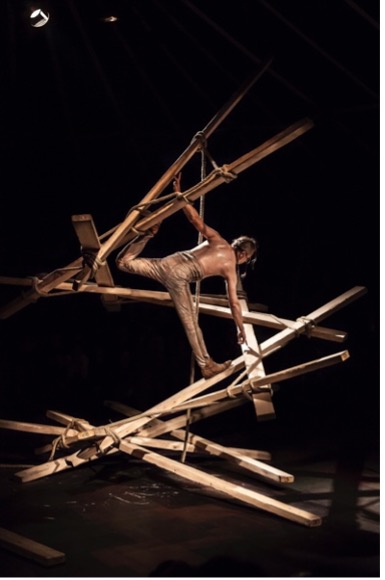
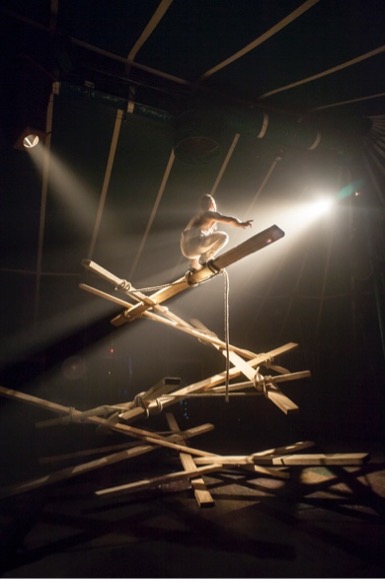
At this point in Secret (temps 2)/Terces, Johann Le Guillerm, that enormous rope around his chest, enters the stage. He is alone. He will remain so. The beams are already there. The stage is home to a rope, wooden beams and Johann Le Guillerm. A feature that jumped out at me: this little world is enclosed and isolated. And that’s not by chance.
To go a step further, we can try to use the reading grid already introduced. Everything around us is the synergy of three fundamental elements of reality: matter, energy and information. These three elements are defined here by their role on stage.
The material: the floor, beams, rope and, of course, Johann Le Guillerm’s body and clothes.
Information: intelligence, Johann Le Guillerm’s thinking, and… that’s all. If not, on the one hand, that stored in the rope, which is not a shapeless mass of textile fibers, but a sophisticated organization of these fibers at different levels, a technical object resulting from a long history. Or, on the other hand, that apparent in the shape of beams: trees don’t produce beams. Some intelligence had to carve them out. By the way, a physics teacher’s thought for the title of physicist Leo Szilard’s article: “On the decrease of entropy in a thermodynamic system by the intervention of intelligent beings.” The exact content of this fundamental physics article is not so directly related to my subject here, but the title is too evocative.
Energy: that’s what it takes to move the beams, the rope and Johann Le Guillerm’s body according to his intentions. They are at the heart of the information that organizes the system, as Leo Szilard puts it. Energy is here a way of naming the transformation of the movement of matter present, through the conservation of that abstract and ultimately obscure quantity that is energy: Johann Le Guillerm’s body moves, so the planks move, change position, so the rope unfurls and comes to bind the beams according to Johann Le Guillerm’s plan. I insist on this description here, because it allows me to highlight a key point: there’s nothing else on stage, but it’s enough for me to experience an extraordinary moment! This statement about matter, energy and information is not an a posteriori reconstruction. This vision came to me during this show, and I found it in many of Johann Le Guillerm’s performances. Most of them, in fact. Almost all of them. It’s a closed, isolated world. Once set up, nothing is added or interfered with. Movements are not driven by motors powered by the infinite electrical grid. No new materials, no new resources. To speak of Johann Le Guillerm’s sobriety here is not mere opportunism. Sobriety, this modest relationship with the world, so intelligent, so sensitive and so physically involved – I’m talking about his body – is at the heart of his work.
He’s probably always been at the heart of his art. As sobriety and the body in movement become ever more important in the world to come, he may well become a prophet of it… My description of this show then follows this thread. No mediation here. No inhuman deployment to lift, move, fix and secure. Johann Le Guillerm can only rely on his prior choice of materials, his intelligence and the energy his body is capable of putting into play at that moment. There is no system for amplifying his intentions through the intervention of an inhuman energy or automatic control system, no other resources, no assurance other than his own. This is the opposite of the contexts in which human life settled in the 20th century: most of our urban activities are based on these immense networks and artifacts (cars, etc.) that amplify us immeasurably, removing risk, uncertainty and freeing up our attention in many moments of our lives. Johann Le Guillerm has none of this. And it’s clearly a choice. In this show, and in many others, he returns to the life before the thermo-industrial society, the one in which only human skill and the 100 watts a trained body can produce for an hour in the service of the show. As a consequence of working in this closed, isolated world, Johann Le Guillerm can only rely on himself. Everything hangs on him, and only him. And nothing is absolutely certain, guaranteed in advance. The risk is there, requiring total commitment and presence at all times. To my mind, this is one of the essential dimensions that conditioned the incredible effect this show had on me, and obviously on the other spectators.
These traits can be found in many of Johann Le Guillerm’s shows. If machines or materials are installed on stage, such as the beams found elsewhere that enable him to build the arches on which he climbs, the movement that makes up the performance appears only thanks to Johann Le Guillerm, thanks to the movement of his body. In the absence of any motor or external source of energy, nothing happens in this closed, isolated world unless he brings energy through his moving body, and, through this movement, precision and rigor in method, organization and intention.
Two of the three levels I’ve introduced in the construction of my message are thus at work. The third level is multiplied tenfold by Johann Le Guillerm’s poetic presence, his gaze, his expressions and his choreography. In turn, this last level is exacerbated by the first two: the expression on Johann Le Guillerm’s face, his posture, installed at the top of his rope-and- beam construction, take on their full intensity: he looks at us from the heart of this little world he has constructed with strength and skill, and which, although close because immediately in front of us as spectators, is inaccessible and even foreign to us. It would be dangerous for most spectators. Fascinating.
Tractochiche, three-cylinder chickpea engine.
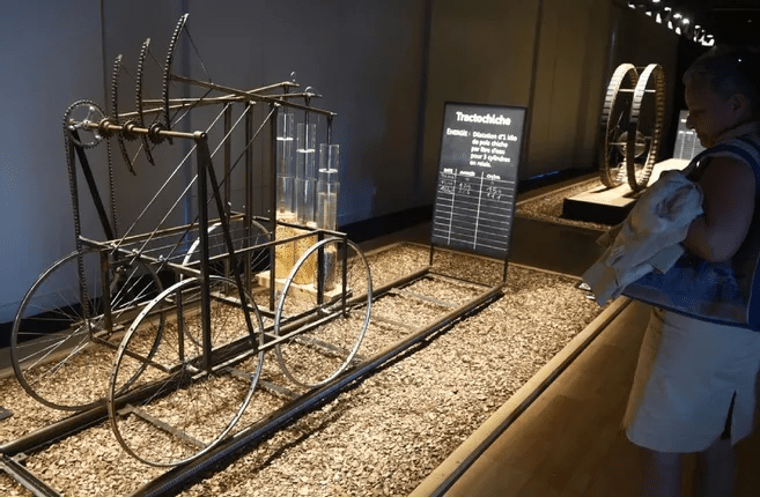
Tractochiche is a motor vehicle powered by a chickpea engine. In the three cylinders, the irreversible expansion of the chickpeas in the water pushes the pistons upwards. A transformation of this translational movement into rotation relies on pieces of bicycle transmission. The resulting movement is continuous, permanent, but indistinguishable from the time of the visit. We rely on the blackboard on which the positions along the path are scientifically recorded day after day. In my memory, it takes the time of the exhibition to cross the room. Slow, continuous, imperceptible movement. Funny too: it’s a motor, certainly efficient since this strange and useless vehicle crosses the room, but also powered by a very modern source of energy because it’s renewable and biological: the chickpea in the water, which expands…
I’m trying to leave out one aspect that fascinates me: the realization of the machine and the engine. When all the world’s physics teachers are teaching thermodynamics, the science of gasoline and diesel engines – the engines that power billions of cars – we’re constantly drawing Johann Le Guillerm’s engine on the blackboard. Instead of chickpeas, instead of the gasoline-air mixture, we install a perfect gas that allows all calculations. We draw, we idealize, we calculate, but we don’t manufacture. In fact, we do, but very rarely, in pedagogical approaches always qualified as
We’d like to call it “new experiences”. At the Centre de Recherche Interdisciplinaire, CRI Paris, with Rafik Affes, PhD in mechanics, we had the students build an engine “for real”. The result: firstly, to reduce the friction of the moving pistons in the cylinders, while maintaining the sealing… It was an exciting moment, both for the students and for us. Tractochiche brings back happy memories of that teaching period, during which I worked with the students and Rafik Affés to build machines that, more often than not, didn’t work. We knew from the outset that this would be the case. Putting ourselves in this situation of failure was deliberate, at the heart of the teaching project.
Clearly, there are multiple subtleties in Tractochiche that I think I’ve guessed at, and which contribute to my pleasure: this machine here only makes sense if “it works”. And making a chickpea motor that doesn’t jam, doesn’t leak, and moves at a (very) low constant speed for a (very) long time isn’t that simple.
For Johann Le Guillerm, the Tractochiche undoubtedly moves forward, but its movement is imperceptible to our eyes. So it’s impossible not to think about it: on the one hand, I see this machine as a physicist, and on the other, I think of Marcel Duchamp’s Inframince in front of this work. The two go together.
I’ve given up trying to put numbers and units here, even though it can’t be that difficult. The speed at which the vehicle moves is determined by the expansion of the chickpeas, which causes the water level to rise. Calculating the speed of the vehicle as a function of the rate at which the pistons rise is based on the “science of gears”. The Johann Le Guillerm company must have had this in mind when building the Tractochiche. In the end, determining the vehicle’s speed is easy. Finding the value of the driving force that makes it move forward at very low speed is trickier. Quite possible, but we’d have to give it some serious thought. It would be interesting because these two quantities immediately determine the power and energy involved. They are probably very small. These considerations are intended to underline the fact that Tractochiche is an obvious meeting place for Johann Le Guillerm and a scientist, both technically and scientifically. It’s also how my fascination with Johann Le Guillerm’s work began.
Here, the encounter is enriched by the imperceptible, and what a pleasure it is to invite Marcel Duchamp to nourish it with the Inframince, a description of which can be :
“An aesthetic concept created by Marcel Duchamp to designate an imperceptible, sometimes only imaginable, difference or interval between two phenomena. When I stand in front of the Tractochiche, I know it’s moving, I imagine it’s always moving, even if I can’t see it. As a physicist, I know I could measure this imperceptible movement and make it immediately obvious. Without much difficulty. A point of separation appears at the heart of the encounter. Johann Le Guillerm, allied with Marcel Duchamp, certainly doesn’t want this technological intrusion that seeks to make obvious and explicit. Perhaps he can find support in the physicist Jean Perrin, who observed the erratic movements of a pollen grain in water at the beginning of the twentieth century, simply with an optical microscope, the consequences and manifestations of the shocks caused by the ever-imperceptible movements of atoms. Jean Perrin knew it: atoms are obviously imperceptible, but they are undoubtedly there, and at the heart of our world, of which they are the matter… That was worth a Nobel Prize in 1926.
These two examples also underline the times of our lives and how we settle into these times. A human life often lasts more than a billion seconds. The second is the shortest duration most evident in our daily lives. Between the second and the duration of our life, we have decided on an organization of time, its structuring: minutes, hours, days, weeks, months and years. We measure our time and we don’t waste it. Who today waits an hour without doing anything? But that’s what we should be doing here: spending a whole afternoon doing nothing, looking at the Tractochiche and perhaps watching it move in front of us. Is this the Marcel Duchamp method, when he staged laziness and the passage of time with his work “Elevage de poussières”, photographed by Man Ray? But that’s impossible today: we’ll say that nobody has time, but above all there’s the very modern impression of an unbearable loss of time. So we put down a marker, set off and come back to measure the distance covered. I think we’ve all become Scientifiss. In our Smartphone world, as we all know, time measurement is available everywhere and in any place.
immediately with unprecedented precision. You don’t have to stand still for long to be sure of a very slow movement when you look at it.
And we move far too fast for the Tractochiche, whose movement is at the very limits of our world. Botanist Francis Hallé always insists: trees are constantly changing a lot, spreading out over large spaces but over very long periods of time. And these movements are totally imperceptible to us. How can we take a time lapse of decades to see the frenetic life of a forest? In this respect, the Tractochiche is a very fast vehicle. Daily science: the times it considers range from, say, the lifespan of certain elementary particles measured at CERN, to the lifespan of the universe. Fast or slow, a matter of perspective.
In physics, important variables come in pairs: position and speed, time and energy. And here, with the chickpeas that drive the Tractochiche, Johann Le Guillerm, like other artists, comes to tell us: movement and the transformation of movement, I know what it is, or at least I see it, but what is this energy that today determines everything, what is a source of energy? I know what movement is, fast, slow, visible and even imperceptible, the movement of objects, of my body, of my body moving objects, and vice versa. But energy… an invention of physicists and engineers that, let’s say from Sadi Carnot onwards in the 19th century, has changed the world, our outlook and life. We don’t even see it anymore, and yet it wasn’t so long ago. The young Sadi Carnot in 1824, in his only book
“Réflexions sur la puissance motrice du feu” sets the course for two centuries. The steam engine was the first universal motor. It provided a rotating shaft that made everything possible. Coal, an infinite resource, feeds this universal machine. The energy available was infinite, and the greatest powers were accessible, far beyond the capacity of the human body, without comparison. Sadi Carnot saw that another world was coming. He wrote about it: it would be the world of energy, or the thermo-industrial society that transforms heat into motion. Efficiency was appalling, but that didn’t matter: the resource was infinite. Electricity would then provide the missing key element: the transport of energy in cables through the movement of electrons. A movement in Dunkirk, in a thermal power plant, passes through high-voltage cables to become a movement again, thanks to a motor in Marseille. Totally imperceptible.
Today, energy is humanity’s greatest challenge. We all believe that it determines our future, and that it’s impossible to do without it. Johann Le Guillerm adds his two cents with Tractochiche. Here, the engine’s energy source is the chickpea. Usually we call it food, food for a body in motion, and not a source of energy. The energy value of chickpeas in joules or calories is, of course, well known. This number and this unit effectively place it in the “energy source” category. A physicist’s word. It’s one of the hallmarks of industrial society: it transforms gasoline, wind, sunlight, coal, gas, nuclear matter… and even life itself, now called biomass, into sources of energy, increasingly electric ones. Everything is used. Watching Tractochiche, I also ask myself this question: “Is eating hummus just plugging your body into an energy source?” Tractochiche doesn’t eat chickpeas…
Johann Le Guillerm, Mario Goffé, the switch and the “on” state
The excerpt from Secret (temps 2)/Terces described here, and Tractochiche too, underline the fact that Johann Le Guillerm’s work has no switches. Generalizing from these two examples
is perhaps a rather hasty assertion, but all the same, it seems to me to be characteristic of his work. And in any case, there’s no such thing in the two examples I’ve considered here. And that’s how I’d like to approach this quotation from Johann Le Guillerm:
“Technology doesn’t interest me much; I prefer to feel the material, what it shows that’s astonishing, it’s its magic that I try to reproduce“.
Johann le Guillerm uses machines, tools and materials, but if there are interactions, transformations and co-evolutions that he plays with intention and determination, there is no “on/off” button on the stage, no switch to turn things on. The switch, the on/off button in an electrical system, is one of the signatures of our way of inhabiting and using the world, of instrumentalizing what surrounds us since the Industrial Revolution. It was invented by John Henry Holmes in 1884, three years after the International Electrical Exhibition, in recognition of the birth of electrotechnology in France. The switch introduces “on” and “off” states. There are no switches in nature. Living things have no “on” or “off” positions. Interactions, flows and crossovers are permanent, and nothing ever reaches an “on” state that is intended to be immutable and defined forever. As for the “stopped” state, it can only be seen in death. And therefore irreversible. Johann le Guillerm settles into these flows, crossings and interactions, and becomes part of this little world, which he installs on stage without really being its master. He must constantly deal with the rules of matter, those discovered by physics, and with the energy his body is capable of deploying.
However, “La Motte” is presented as a futuristic plant planet 2.5 m in diameter, bristling with edges and in perpetual revolution. Here, on the other hand, there’s an electric motor, an energy source and control electronics containing the system’s code, information and “intelligence”. The latter contains the switch and manages the “vital” flows of energy and information. These are the essential characteristics of technological systems. La Motte is a highly sophisticated technological device. A form of paradox? Or at least a contradiction in what I’m saying?
La Motte is the result of a collaboration between Johann Le Guillerm and Mario Goffé. I also had the pleasure of talking at length with Mario Goffé. An artist, a physicist and Anne Dubos, an anthropologist specializing in the body in motion, also a transmedia artist, we were installed in the giant industrial wasteland that is the former North Port of Chalon-sur- Saône. Her works, installed there like a wagon on its tracks, were a source of great inspiration. His poetic robotics takes its place at the heart of the technology that is transforming the world, seizing on the triptych energy-matter-information, but then immediately hijacking it to show us the extent to which the technology produced by industrial companies defines our lives.
La Motte is a large, heavy device. We find this characteristic in most of Mario Goffé’s productions, such as the vertical stacking of buses in a staggering sculpture that hijacks technology. Handling the very heavy and cumbersome is quickly inhuman. The energies involved are far beyond those compatible with the human body. The person involved can only be a driver. They find themselves at the controls, flipping switches to power and engage flows from the immense networks that have criss-crossed the planet since the 20th century.
I’m not contrasting Mario Goffe and Johann le Guillerm here, the former working at the heart of technology to subvert it, the latter working outside it with his body in motion. I
On the contrary, I think they’re both explorers of the foundations of our humanity, who inhabit reality by interacting with it and with other human beings. Their meeting to produce La Motte, this capricious little planet, is a crossroads between these two very different universes: one wants to tame and redefine the place of the switches that manage the flow of energy and information, the second disqualifies them and, in his representations, places his body at the heart of the device to be the unique and living source of the energy and intelligence that transforms matter.
 Teaching, exploring, learning with students...