Translated using Deepl from original French article published here: March 2, 2022, 20:42 CET
Lucie Boutelant is co-author of this article. She is a designer.
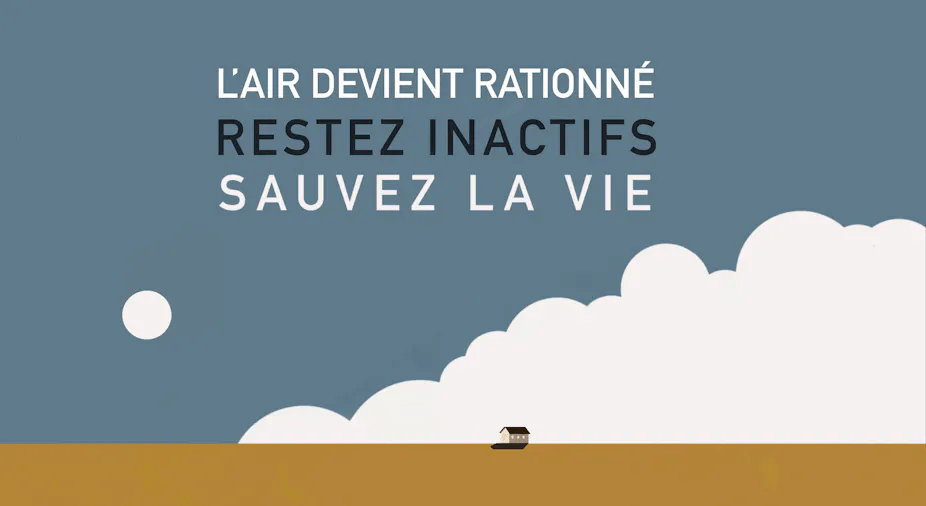
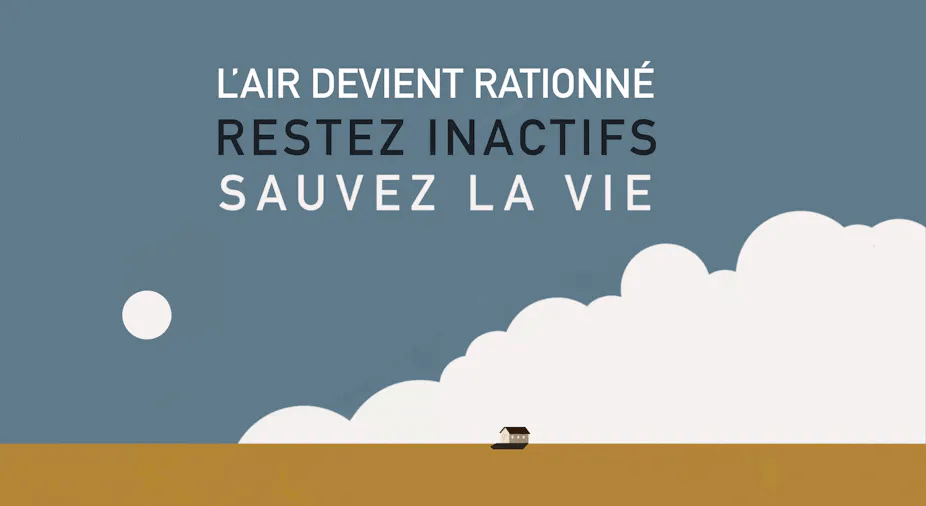
Poster inspired by Mathieu Persan’s “Stay at home”, distributed during the first containment of March 2020. Lucie Boutelant, CC BY-NC-ND
In 2021, in his “Amazonia” exhibition, photographer Sebastião Salgado showed us a world where water is everywhere – on the ground, in the clouds, present in all living things. A bit like the air we breathe.
But today, in our cities, water is collected, channeled, treated, distributed and sold. Will the same soon be true of our air?
“Air is the only matter we inhabit”. This quote, reported by architectural historian Cyrille Simonnet in Brève histoire de l’air, is attributed to Yves Klein. Do we often think of “inhabiting matter”? Not really! Yet we live in the air, that omnipresent material in our daily lives that we neither see nor feel.
Invisible, 21% oxygen and 78% nitrogen, air, our habitat by default, constantly surrounds and encompasses us. It is as much a fascinating resource as it is a concern.
Physicist and designer, we have written this text combining our two points of view and our two observations: that of figures and facts, and that of a sensitive observation of society. We try to distinguish the social and psychological conditioning tools at work at the heart of this shortage of (fresh, accessible) air that’s hanging over our heads.
And we imagined a fictional, dystopian everyday life: oxygen is becoming scarce and, to cope, society intervenes everywhere and conditions everyone.
Humanity’s flippancy: the air is there for us!
Today, we need to focus our attention on preserving our air. How can we become aware of this?
Today, we’re talking about carbon sinks and oxygen producers on Earth – trees and phytoplankton. These have enabled us to consume and unconsciously consider air, and therefore oxygen, as an unlimited resource. Until now, anyway.
The relationship between mankind and the air is astonishing, almost perverse. We learn very early on that air is one of the essential conditions for life on Earth; we destroy this life and soil the air relentlessly.
But as we enter the Anthropocene, we come up against the physical and biological limits of the Earth, which cannot be at the exclusive service of humans. Whether we like it or not, humanity is an integral part of living organisms immersed in air.
Greenhouse gas emissions (GHGs), atmospheric pollution and airborne viruses are altering our very breathing, and will continue to transform our future, affecting us physically at the deepest level.
The atmosuicide trap
Are we condemned to atmosuicide? This term is inspired by another, atmoterrorism, a neologism introduced by contemporary German philosopher Peter Sloterdjik in his book Écumes, Sphères III, to describe the voluntary poisoning of the atmosphere inaugurated on a massive scale during the First World War.
Since we’re well aware of the harmful effects of GHG emissions, volatile waste and all this “air pollution”, it’s no longer crazy to talk about “atmosuicide”.
It’s hard toescape it, even if the damage we cause isn’t necessarily visible to the naked eye, so we tend to think it doesn’t exist. Indeed, how can we imagine that one day we’ll be faced with a shortage of breathable ambient air, a lack of oxygen?
Covid in the air, a collective awareness?
The SARS-CoV-2 virus, agent of the Covid-19 pandemic, has brutally changed our relationship with air. Like the air that surrounds us and which it has invaded, it is invisible. As it also lives in the air, it has forced us humans to be constantly wary of the air, this natural environment to which we pay very little attention.
Faced with the threat, we accepted almost permanent constraints to breathe air filtered by a mask. This widespread suffocation probably changed forever our apprehension of air, our awareness of its presence and its crucial importance.
The arrival of Covid-19 changed all that. The preoccupation with clean air suddenly took hold. The pandemic is the result of an exchange of viruses through air passing from lung to lung, at the heart of intimacy. The mask, a physical and psychological barrier, made this usually unconscious sharing of air obvious.
It’s an imperceptibly small thing that disrupts our relationship with our environment, and creates chaos in our social relations. In 1984, in his book La Conscience des mots (The Consciousness of Words), writer Elias Canetti put it bluntly:
“Air is the last common property of the collective. Everyone has a common right to it. It is not distributed in advance; the poorest can even help themselves.”
In March 2020, the anti-Covid mask canceled this unconscious, natural, spontaneous and free sharing. It materializes the worst threat posed by this virus: no longer being able to breathe the air.
Once upon a time, there was a world where the air lacked oxygen…
We’ve created a fictional scenario: what if the oxygen in theair began to run out? How do we imagine our adaptation, our choices (including ethical ones), our technological and industrial responses, and the changes in everyday life?
In this fictional world, humanity is driven to stock up on oxygen, just as we usually stock up on water, food or money. In this imaginary world, oxygen production is massively industrialized and becomes the object of international trade.
A new lobby is building up around O2Liquide, the global oxygen giant. The vital need for air allows O2Liquide to install its oxygen, practically replacing the now insufficient ambient air. With its dispensers in public spaces, it rations and redistributes oxygen to the population. Eventually, the power of material and economic control over oxygen becomes such that it leads to the establishment of a global totalitarian regime on Earth.
“Since everything has to be profitable, we’ll privatize the air we breathe,” Grand Corps Malade tells us in his song “Course contre la honte” in 2014.
Everything is determined and organized around this constant search for oxygen. Saving money transforms Earthlings, who seek to reduce this consumption by avoiding all forms of stress, and even trying to control their heart rate.
The world of health care is evolving in tandem, to ensure that the general oxygen economy of each individual is respected. Sporting activities are prohibited and hypothyroid treatments, which slow down the basal metabolism of individuals, are forcibly administered. Inactivity is rewarded: when detected, sitting or lying down earns the individual portable oxygen refills.

Posters inspired by government communication during the Covid health crisis. Lucie Boutelant, CC BY-NC-ND
Whether it’s furniture, leisure, hobbies or work, everything now revolves around the oxygen economy, a new form of currency.
An insidious media environment conditions people’s lives, both socially and individually. Design is helping to reshape or rebuild these lives. Tools installed by designers (applications, social networks, public displays, advertising campaigns, prescriptions/recommendations…) are invading the world, imposing themselves everywhere and on everyone, conditioning each and every one.
Amazing dialogue
This fiction is first and foremost a dystopian extrapolation. But there is no fatality. The tree rooted in the earth evaporates masses of water in the air, thanks to the heat generated by solar radiation. These form the flying rivers, those immense clouds over the Amazon, so dear to Sebastião Salgado.
The designer then suggests an entirely different imaginary, another point of departure, echoing the words of Diogenes Laërce about the pre-Socratic philosopher Empedocles:
“His theories were as follows: there are four elements, fire, water, earth and air. Friendship binds them together and hatred separates them.”

That’s a completely different program for the people of Earth.
 Teaching, exploring, learning with students...