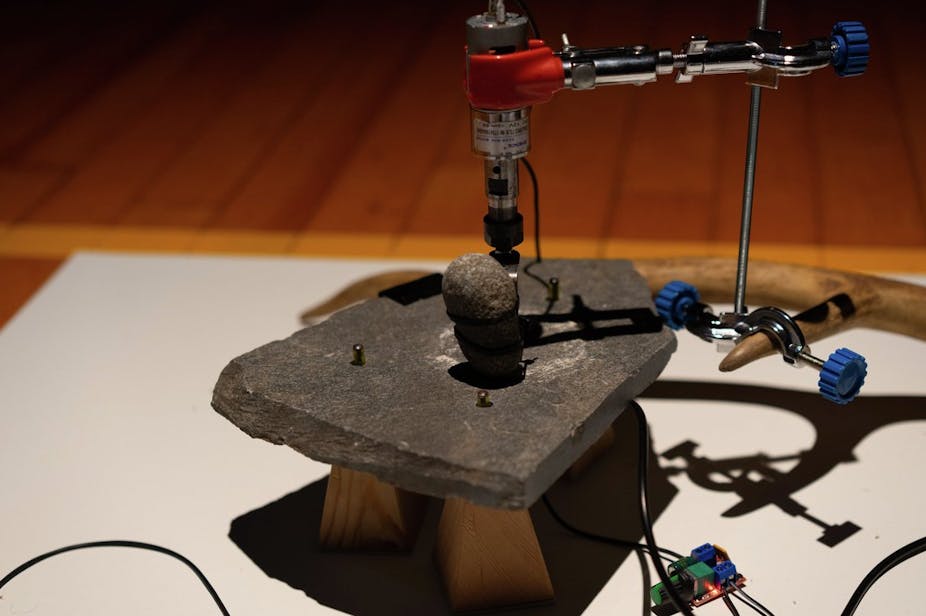
Tarek Atoui has exhibited his work “The Ground” at the Bourse du Commerce, the contemporary art center created by François Pinault, until September 6, 2021. He had already presented it at the Venice Biennale of Contemporary Art in 2019.
Tarek Atoui is first and foremost a musician, specializing in electroacoustics. As an artist, he explores the vibrations of matter and the resulting vibrations of air – in other words, the sounds we hear. With “The Ground”, he takes us to the heart of the infinite sounds of the world, inscribed in matter, in reality. These sounds, permanent surprises, are created by contact, shock and friction, in the disordered movements of his devices.
Frugal lutherie
It was by chance that I discovered this laboratory for the exploration of sound produced by mechanical vibrations from improbable instruments, like frugal, chaotic lutherie. I can’t approach this work as a musician, but as a physicist, I was at home. But “The Ground” shows that we can all share the emotions created by this exploration of vibrations, by the surprises they generate, and by what they reveal to us about the imperceptible intimacy of the constant rustling of the world around us, movements that actually reach down to the atomic scale.
When Georges Charpak wanted to hear from ancient potters
This work reminded me that, on the death of Nobel Prize-winning physicist Georges Charpak in 2010, Mathias Fink – a French physicist and world specialist in acoustics – recounted in tribute that he had this crazy project: to find out whether the stylus used by Greek potters in the time of Pericles had, through the transmission of mechanical vibrations, “printed” conversations.
In the 19th century, eThomas Edison recorded and reproduced sounds with a needle that marked and then read a wax cylinder. I remember Georges Charpak’s comment. As a young physicist in Grenoble, I had a mocking smile on my face, such was the absurdity of it all. But I was wrong! Especially since, a year earlier, the Nobel Prize had rewarded IBM researchers for visualizing atoms on a surface using a scanning tunneling microscope. This nano-sensor is, after all, just a tip on a surface controlled on an atomic scale. Everyone thought the scanning tunnelling microscope was impossible precisely because of the ambient vibrations caused by the omnipresent mechanical noise.
Georges Charpak’s idea fits into this whole context. He obviously knew the enormity of the difficulty, just as he knew that it was equal to his interest. What a fascinating idea: listening to the potters of Pericles! Just thinking about it is enough to make your eyes wander. It doesn’t matter if it can’t be done, this crazy idea alone is a magnificent gift.
Mechanical vibrations make the world sound
As a musician and minimalist luthier, Tarek Atoui explores the infinity of sounds that can make music and invade our space. The sounds we listen to can’t be reduced to a world of 12 notes, solfeggio and acoustic or electroacoustic musical instruments, however rich and fertile the world of music may be. With “The Ground”, we return to the essence of sound, i.e. mechanical vibrations of matter coupled with those of air transmitted to our ears after multiple transformations. Tarek Atoui enters a surprising and uncontrollable space, with no immediate reference points. This work opens up an exploration equipped with fragile instruments and situations that produce chaotic, unexpected and surprising sounds. We imagine Tarek Atoui trying again and again, in a process of constant discovery.
Play until inaudible, then process and amplify
I don’t know how Georges Charpak imagined, if not doing the experiment, at least trying something. But I’m sure of one thing: there would have been a sensor, signal processing and amplification. Tarek Atoui is an electroacoustic musician. He knows and shares this instrument-sensor-signal-amplification chain with physicists. As we can see in “The Ground”: the sensors can detect very weak vibrations, and then the electronic amplifier adds power to the signal, thus increasing the sound volume. This makes it possible to play even below the threshold of perception, to use vibrations that are weak, subtle, delicate but a priori inaudible.
By using sensors to measure the trace of the potter’s voice, we would have been looking for quality of measurement and precision, the guarantees of authenticity when listening. For the musician, therein lies the difference. He doesn’t necessarily aim for faithful rendering. He follows his own creative process, and is free to accept this vibration for what it is, or to transform it into music.
Finding the unexpected in the uncontrollable
Above all, the devices in “The Ground” return to the fundamentals of musical instruments: friction and contact, in other words, shock and percussion. By using electroacoustics to separate the nature of sound from amplification, Tarek Atoui explores fleeting mechanical vibrations and succeeds in conveying the extent to which shock and percussion open up creative spaces.
Tarek Atoui can change everything at will, to endlessly welcome the surprises of an ever-renewed sound, relying on the uncontrollable properties of contact and friction in movement. A violinist knows how to control the friction between bow and string. The development of the hammer-key-string system in a piano, enabling the control and repetition of the hammer strike on the string, is the great technical history of the piano. In both cases, violin and piano makers have become famous for the intelligence, knowledge, precision and rigor required to control vibrations and sound.
Celebrate Sébastien Érard, inventor of the double escapement for the piano.
These instruments demand maniacal care and attention. This is not to say that Tarek Atoui’s reliance on the surprises generated by his devices is a recipe for complacency. The sound he listens to doesn’t allow for that. What he does remains difficult and demanding, because he chooses the materials, sets up the movements and constructs the situations that produce the surprises he’s looking for. He takes maniacal care in capturing, processing and amplifying signals. Playing with the contact and friction that introduce this unexpected, this singularity, enables him to be on the lookout for what interests him: the sound we listen to.
 Teaching, exploring, learning with students...