Artists’ bodies in motion versus the disembodied digital future
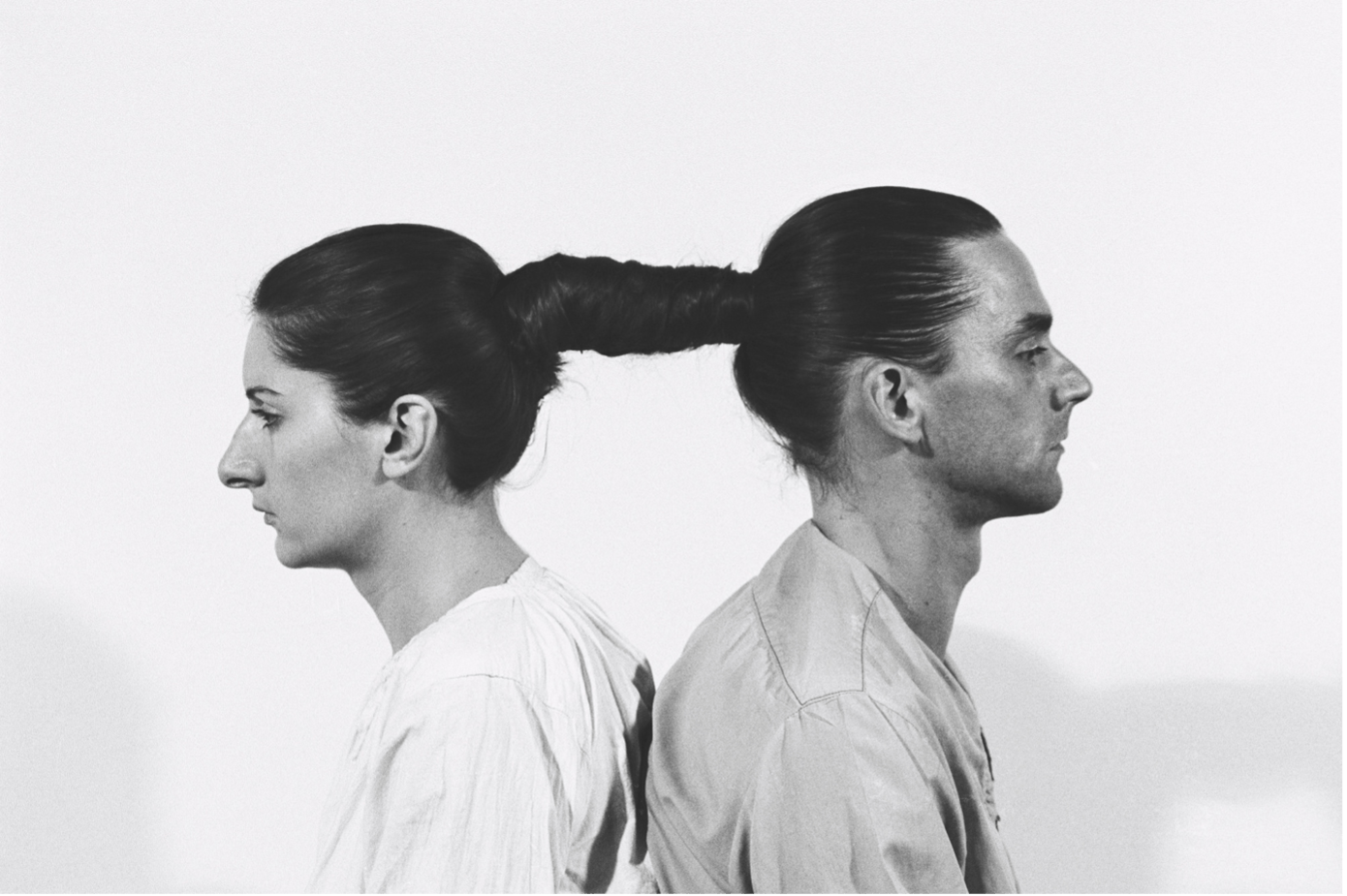
Over a period of twelve years, from 1976 to 1988, performance artists Marina Abramovic and Ulay (Uwe Laysiepen) explored a personal and artistic fusion. Their performances are breathtaking, both spectacular and physically complex. They engaged them at the limits of the body, of its strength, resistance and exhaustion. Sometimes they were even truly dangerous, and very often extremely painful. From 1976 onwards, they will be the couple who, through their performances, seek to become “a two headed body”. Two distinct individuals interacting towards a single entity, “a body with two heads”, as she puts it!
Around 1970, in a famous drawing, Alan Kay anticipated the new human interactions brought about by the digital world to come. It will be disembodied, with bodies no longer necessary. This drawing is practically a prophecy, infinitely ahead of the reality of computers at the time!
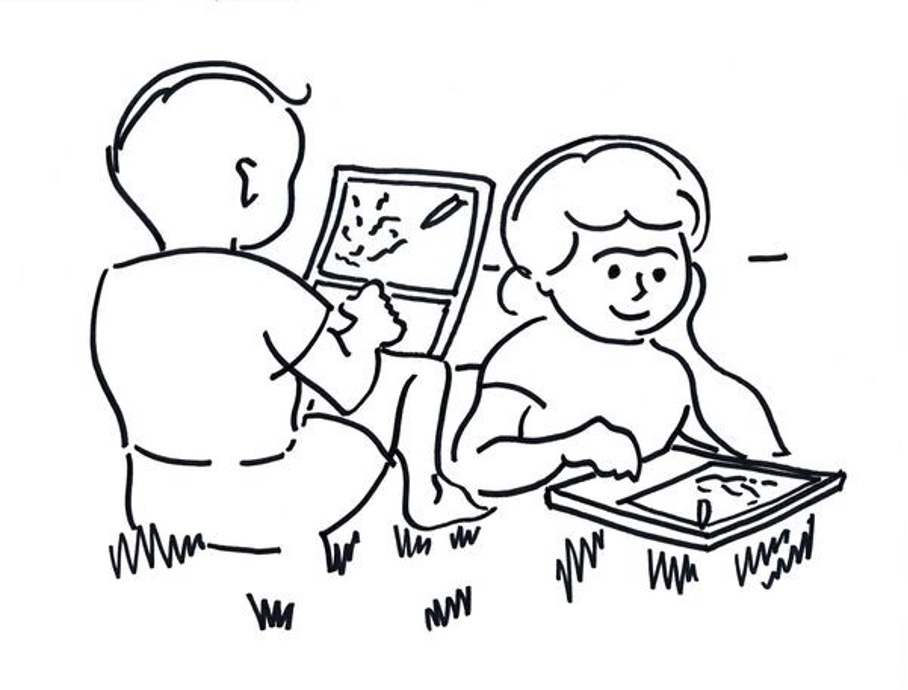
A personal computer for children of all ages”. (from a 1968 drawing by Alan Kay)
A physicist watches these artists explore the physical interactions between bodies
As a physicist, I’d like to share my amazement at these performances. The digital age is clearly being invented and prepared. The word “computer” was chosen by IBM with the help of French Latin philologist and theologian Jacques Perret. In contrast, and independently, Marina Abramovic and Ulay return to the elemental physical interaction between two bodies in motion.
Physicists specialize in describing interacting systems. The simplest case is the so-called two-body problem: two planets in classical mechanics, a proton and an electron to make a hydrogen atom in quantum physics. We can extend this to two systems, each with its properties as an isolated system, and the interactions (gravitational, by contact, by friction, thermal by exchange of heat or light, electrical, magnetic, by exchange of particles, molecules…) that often occur when they come together. Considering the works of Marina Abramovic and Ulay on this basis may seem a strange thing to do. But I did. Systematically, and I was surprised, in fact flabbergasted.
Silence! No one speaks! Performance in progress.
Marina Abramovic and Ulay see themselves as two interacting systems, but only through their two bodies in motion. They have deliberately suppressed an essential interaction between them: language! Nothing less. In these performances, they don’t speak, they don’t write. They eliminate this interaction, which is essential to our exchanges in real life and, of course, in the world of exchanges via Smartphones. They also eliminate any form of representation on a medium. No painting, no picture, and of course no screen. Marina Abramovic quickly gave up painting when she discovered the power of performing “here and now” in front of an audience. Referring to her 1973 performance Rhythm 10, in which she frantically stabbed knives between her fingers, thus brutally cutting herself, she wrote in her 2016 autobiography Walk through the walls:
I had experienced absolute freedom – I had felt that my body was without borders, without limits; that pain didn’t matter, that nothing mattered at all – and this intoxicated me. I was drunk on the irresistible energy I had received. That’s when I knew I’d found my medium. No paint, no object I could make could ever give me that kind of sensation, and it was a sensation I knew I had to seek out, again and again and again.
So what’s left? The physical interactions between these two bodies!
I’m looking at you, you’re looking at me, we’re touching, we’re bumping into each other, we’re hitting each other, we’re tying each other up, we’re exchanging air in a kiss until we faint, we’re shadowing each other… or we’re doing nothing but staring at each other without moving. Often, the performance lasts for hours on end, and the pain and fatigue we endure bring the intensity to the very limit of what we can bear. It’s all very impressive!
Reading the autobiography, you’d think they’d be creating something without an overall plan. And yet, with this video https://youtu.be/_dCIa8n0HZQ?si=KJWr4eXZvIbHZxAR , you’d think they’d drawn up a list of possible interactions between two bodies, created a performance for each line on the list, and pretty much exhausted the list. This idea first occurred to me during a visit to the Marina Abramovic exhibition at London’s Royal Academy in 2023. A retrospective both remarkable and difficult to follow. A compendium of their collaboration, presented in one place, and confronted in the space of two hours. A real test!
In 1976, Ulay discovered Newton’s pendulum, and they created the performance Relation in space.
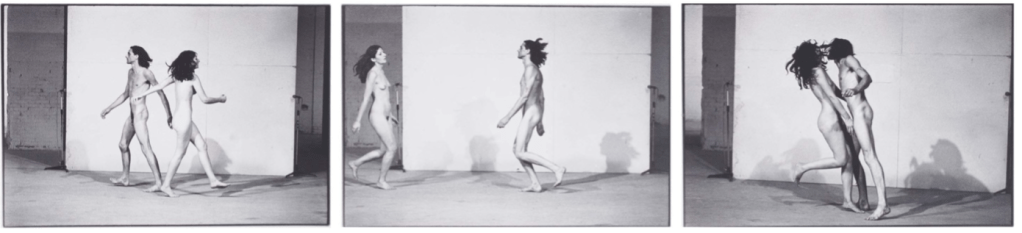
Relation in space (58-minute performance) XXXVIII Biennale, Venice, 1976
They run towards each other, naked, and every time they do, they collide. For real, and of course they hurt each other. And as always with these 2 artists, obviously much to Marina Abramovic’s liking, it lasts. They repeat these races and collisions for an hour. Marina Abramovic wrote down the genesis of the performance they produced in 1976: Newton’s pendulum was their inspiration.
Newton’s pendulum is a star of physics. Two essential laws of conservation in physics are mobilized to describe the motion of colliding balls: that of energy and that of momentum. Marina Abramovic describes how Ulay found a Newtonian pendulum to play with, and how this led to their performance. These explorers of the physical interactions between bodies then go on to create a series of performances.
The Mac Intosh and the Great Wall of China
In 1984, Apple unveiled the Mac Intosh. With its graphic interface and mouse, it amplified the transformation of our interactions with and through digital technology. During the 80s, Marina Abramovic and Ulay struggled to convince the Chinese authorities to let them walk the Great Wall of China. In 1988, they each set off on one side of the route, walked some 2,500km and met in the middle. During the weeks of the walk, there was no contact between the two, but they knew they would cross paths. Another form of interaction is explored here. On the Great Wall of China, you’re bound to run into each other. Only one path is possible. All you have to do is set the starting conditions in advance: where each person is going, in what direction and when. Then there’s a close link between the two, and they walk with the certainty of meeting. Electromagnetic waves have long been used to transfer information, providing an instant and permanent link between two people. Marina Abramovic and Ulay do without these waves. It’s a timeless, universal link between two human beings that they find in this walk. Deliberately without technology. The arrival will also be the programmed end of their couple and their artistic collaboration.
The artist is present: two people looking into each other’s eyes
2007 saw the launch of the first smartphone, the Apple iPhone. It will take over the world and be a major vehicle for the digital transformation of humanity in the 21st century. Alan Kay’s program comes to fruition, and the body disappears. In 2010, at the MOMA in New York, Marina Abramovic proposed this performance: The artist is present. It couldn’t be simpler. A table, two chairs. She sits motionless for hours, and anyone who wants to can sit opposite her. No gestures, no words, just eye-to-eye. Everything has been photographed. The images of the faces speak for themselves: intense human interaction conveyed by the gaze alone, without contact, without sound, without movement.
This “The artist is present” performance was also a moment of reunion between Marina Abramovic and Ulay two decades after their separation.
With this exhibition of a relationship to the other stripped of everything, Marina Abramovic puts us back at the heart of our humanity. Interaction “here and now”, silent, patient, between motionless bodies… timeless, universal physical interaction, from before the technologies that have built the present world and transformed our lives.
 Teaching, exploring, learning with students...