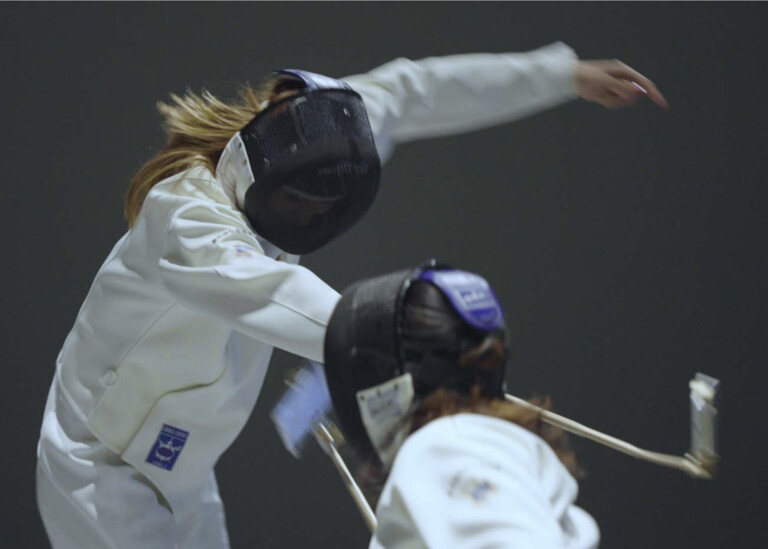
From October 2024 to January 2025, artist Qingmei Yao exhibited Fencing: Landscape Fight at the Centre Pompidou as part of the exhibition China: A New Generation of Artists. Qingmei Yao placed two fencers on their usual piste. However, she replaced the two foils with two selfie sticks equipped with smartphones. Consequently, gazes, body movements, and gestures were transformed. Fencing disappeared; the smartphone took over. This simple alteration of the rules governing interaction between two people changed their world. Here, the artist provides a relentless and remarkable demonstration.
At the Centre Pompidou, the work was presented as a film.
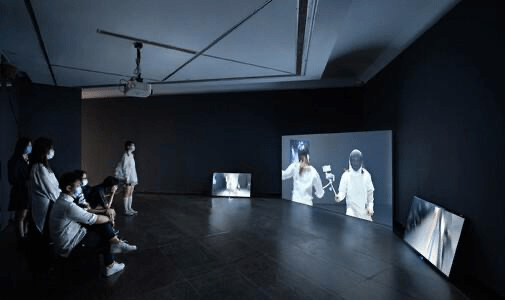
(Source: https://www.shanghartgallery.com/galleryarchive/work.htm?workId=111272)
At the Centre Pompidou, the installation featured three screens, as seen in the image above. A large screen displayed the couple of performers, the artist Qingmei Yao giving instructions, and an audience. Two smaller screens showed the footage recorded by the smartphones. There were no fencers and no artist physically present in the China: A New Generation of Artists exhibition at the Centre Pompidou, except on the large screen with the image of the audience during the performance. In Fencing: Landscape Fight, Qingmei Yao explores the interaction between two bodies in constant face-to-face motion. Initially, this interaction is constructed through gaze and touch via the foils. Thus, the modalities of interaction first establish themselves through fencing and its codified exchange rules.
Fencing: Landscape Fight — Constructed within the world of fencing
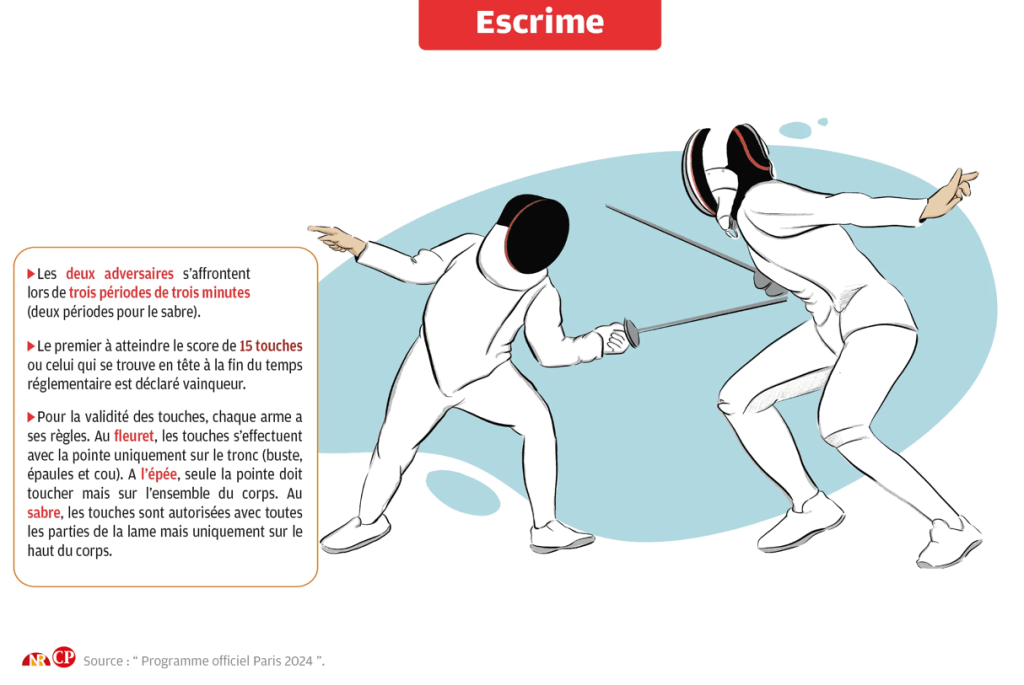
Fencing is governed by very strict and ancient rules framing the “sword fight.” Having become a sport, fencing has featured in every edition of the modern Olympic Games since 1896—a rarity among Olympic disciplines. For Qingmei Yao, it provides a strong, clear, and universally understood starting point. Fencing involves two bodies moving back and forth along a straight piste, always face-to-face, never turning away. In her work, Qingmei Yao maintains the concept of touch as it exists in fencing: physical contact occurs solely through the interposed foils. Thus, the initial phase of the piece is complete—movements replicate only those of fencing, performed silently from start to finish. At the beginning of the performance, the man and woman demonstratively execute basic foil movements—forming the lexicon of the ensuing choreography: the duel.
Fencing as a model of the pre-digital world
By grounding her performance in fencing, Qingmei Yao anchors her work in the longue durée of human civilization, referencing the diverse cultures that refined the art of fencing to a high degree of sophistication. The scene is thus set: humanity, pre-digital and pre-industrial, limited in energy resources but already mastering advanced metal transformations, particularly high-grade steel metallurgy. The digital society upends this tradition. Fencing does not withstand the digital era. Replacing foils with selfie sticks and smartphones marks a colossal temporal, technological, and cultural leap. This is our world today: smartphones and selfie sticks are omnipresent and instantly recognizable. Indeed, they profoundly alter human relationships through selfie-taking—alone or in groups—and through the recording of images that immortalize the moment. Qingmei Yao investigates this transformation.
From foil to selfie stick: A transition between worlds
Qingmei Yao simply replaces the foils with selfie sticks holding smartphones. Once the duel resumes, the smartphones continuously film and project images onto screens. Initially, she instructs the couple to demonstrate new choreography patterns—the highly codified selfie postures seen at tourist sites worldwide. Unlike fencing, these postures constitute a universal lexicon familiar to all. The rules of interaction between the pair are thus profoundly altered, even though the piste, fencing attire, and face-to-face stance remain.
The duel resumes with selfie sticks—everything changes
Fencing initially structures the situation: the two opponents engage in combat, but the smartphones soon dominate. The artist’s vocal instructions guide the performers to seek controlled framing on the screens. On the piste, the movements of the selfie sticks and bodies become dictated by the desire to properly frame the image. A new interaction emerges, mediated by technology. The performers see each other through the screens, with their physical distance determined by the desired framing: a full body, a torso, a face, or a limb.
The smartphone outmatches the foil
Technology transforms space, its occupation and perception, and movement’s vision. This artistic exploration underscores screens’ powerful ability to capture attention and stand between individuals. A new world emerges with altered human relationships. Framing choices direct the gaze onto the screen. The need to frame the body, torso, or head establishes partner distance. To keep bodies at an appropriate distance, they must remain identifiable on-screen—whether whole or partial. Without foils, touch vanishes. In this world, there is no touching, no direct gaze.
What happens with extreme close-ups? Surprise.

Finally, Qingmei Yao asks the couple to film body details in extreme close-up—a shoulder, a cheek, a chin, a knee. Everything shifts again. The smartphones’ dance around the bodies, capturing minute details without physical contact, introduces a new and unexpected sensuality. The bodies brush near each other; details appear on-screen. But do these details retain meaning? That seems beside the point. The focus—the act of framing—becomes paramount. A new duet emerges: filming each other’s bodily details at close range. The bodies undulate, seeking each other out. Direct interaction returns, yet gazes remain fixed on screens. A novel mode of presence arises: silent, bodies grazing without touching, eyes glued to small screens, gazes no longer meeting. Sensuality persists, mesmerizing the audience. The film captures their fascination—viewers at the Centre Pompidou found themselves doubly enthralled.
(Source: http://www.leapleapleap.com/2024/11/the-aesthetic-transformation-of-motion-a-dialectical-take-on-sports-and-contemporary-art/)
Bodies in close proximity, as in Marina Abramovic’s performances
Qingmei Yao reveals how profoundly technology transforms human interaction and presence. The surprise lies in discovering a form of hybrid intimacy: while gazes remain screen-bound, proximity and space-sharing allow bodies to reclaim interaction control, relegating screens to a secondary role—though they still fix gazes within the screen space, preventing the mutual gaze fundamental to Marina Abramovic’s The Artist is Present.
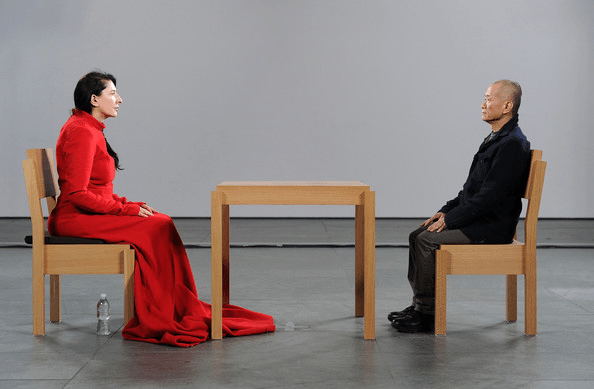
Marina Abramovic and bare human interactions in the 20th century
Born in Belgrade in 1946, Abramovic explored bodily interactions—often nude and silent—from 1976 to 1988, culminating in 1992 with a trek along the Great Wall of China in opposite directions, meeting in the middle. This artistic and romantic journey found an epilogue at MoMA in 2010, with The Artist is Present: two people seated face-to-face, gazes locked.
Qingmei Yao and Marina Abramovic: A crossing of paths?
Born in China in 1982, Qingmei Yao studied in France and lives in Paris. Created in 2021, Fencing: Landscape Fight emerged nearly half a century after Abramovic’s explorations. An eternity separates their worlds: Abramovic’s is devoid of digital influence, while Qingmei Yao’s work springs from the digital age’s fabric. Yet, Qingmei Yao steps onto a similar stage, establishing a laboratory of bodily interactions in the digital era. She probes how new technologies reshape the relationship between two moving bodies—at the core of our humanity, now deeply transformed and unpredictably evolving.
Fascinated as a physicist
Writing about this piece feels almost instinctive for a physicist. Nobel laureate P.W. Anderson wrote in Basic Notions in Condensed Matter (1977), speaking of a stone or a ruler: “We are so accustomed to this property of rigidity that we fail to recognize its almost miraculous nature—that it is an ‘emergent property’ not contained in physics’ simple laws, though it results from them.” Physicists strive to identify elementary interactions underlying matter to understand emergent collective behaviors—often yielding delightful surprises. This analogy perhaps (or perhaps not) led me to an unexpected perspective on Qingmei Yao’s work—an enriching discovery and a testament to this artist’s compelling force.
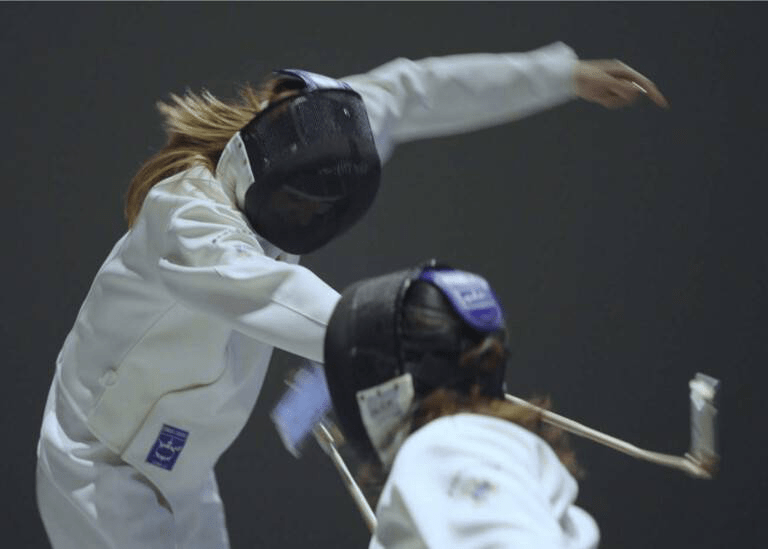
(Header image from: https://www.shanghartgallery.com/galleryarchive/work.htm?workId=111272)
 Teaching, exploring, learning with students...